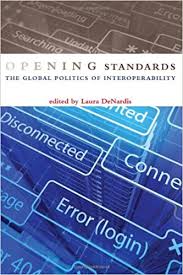
Opening Standards: The Global Politics of Interoperability

Opening StandardsNew MIT Press Book  – Opening Standards: The Global Politics of Interoperability

Openness is not a given on the Internet. Technical standards–the underlying architecture that enables interoperability among hardware and software from different manufacturers–increasingly control individual freedom and the pace of innovation in technology markets. Heated battles rage over the very definition of “openness” and what constitutes an open standard in information and communication technologies. In Opening Standards, experts from industry, academia, and public policy explore just what is at stake in these controversies, considering both economic and political implications of open standards. The book examines the effect of open standards on innovation, on the relationship between interoperability and public policy (and if government has a responsibility to promote open standards), and on intellectual property rights in standardization–an issue at the heart of current global controversies. Finally, Opening Standards recommends a framework for defining openness in twenty-first-century information infrastructures.Reviews of New MIT Press Book Protocol Politics

Recent MIT Press Book – Protocol Politics: The Globalization of Internet Governance

Reviews and Testimonials

“In this remarkable, illuminating book, Laura DeNardis demonstrates that technoscience is politics and that Internet protocols are embedded with values, not simply ones and zeros. Protocol Politics offers a truly interdisciplinary perspective: DeNardis has a scientist’s grasp of the technology, the social scientist’s insight into the interests at stake, and the humanist’s concern to build an Internet that promotes human values. This is a must read for anyone interested in one of the most important political fights of the twenty-first century.”—Madhavi Sunder, Professor of Law, UC-Davis
“Laura DeNardis has written a superb new book.”- Danielle Citron, Professor of Law, University of Maryland Law School writing in Concurring Opinions )
“How can a string of 32 (or 128) binary numbers get involved in international debates about the Global South, citizens’ rights, market economics, and Bush era unilateralism? In this lucid work, DeNardis weaves a wonderful tale about internet addressing-demonstrating the wider thesis that the arcane world of standards setting is a site of some of today’s great questions, and that we as citizens should understand and be engaged in these debates.”—Geoffrey C. Bowker, Mellon Professor of Cyberscholarship, School of Information Sciences, University of Pittsburg.
“A fascinating account of a societywide technological upgrade that affects us all. DeNardis uses the ongoing drama of a new Internet protocol—IPv6—to explore in depth how standards and governance are related.”—Milton L. Mueller, Professor, School of Information Studies, Syracuse University——-
“Technical standards are among the most powerful and least understood features of the Internet. In Protocol Politics, Laura DeNardis shines a much needed light on their crucial role in our networked world, demonstrating how Internet standards affect civil liberties and shape global economic power, and how countries and corporations alike struggle with each other to influence and control them.”—Jack M. Balkin, Knight Professor of Constitutional Law and the First Amendment, and Director, The Information Society Project, Yale Law School
Follow

Get every new post delivered to your Inbox.

%d bloggers like this: